
A carpenter. A documented fortune teller. One of the final people hanged during the Salem Witch Trials. And the 8th great-grandfather of The Charmed Emporium founder Michelle Peters.
Samuel Wardwell was an Andover, Massachusetts carpenter and fortune teller who was accused of witchcraft during the Salem Witch Trials of 1692. After initially confessing during his examination, he recanted. Wardwell was executed by hanging on September 22, 1692. Michelle Peters traces her direct family line to Wardwell as her 8th great-grandfather.
Samuel Wardwell lived in Andover, Massachusetts with his family during the late 1600s. Court records identify him as a carpenter, but another part of his life would ultimately become important during the Salem Witch Trials.
Wardwell was known for telling fortunes.
This is not a modern legend added to his story centuries later. His fortune-telling appears directly in surviving records from 1692.
During his examination, Wardwell acknowledged that he had been involved in “telling of fortunes, which sometymes came to pass.”
Other people from Andover also testified about his fortune-telling. One witness described seeing Wardwell look at people’s hands before making predictions. Another testified that Wardwell had frequently told young people their fortunes.
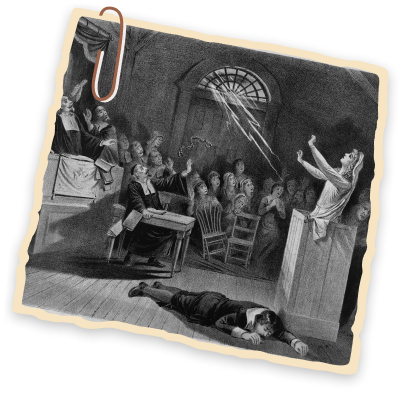
In a community increasingly consumed by accusations of witchcraft, practices that may once have been treated as entertainment, folk magic, or divination suddenly carried enormous risk.
Yes.
Samuel Wardwell’s connection to fortune-telling is one of the most clearly documented parts of his story.
The surviving Salem Witch Trials records contain testimony from multiple people who said Wardwell told fortunes.
Ephraim Foster testified that Wardwell predicted that Foster’s wife would have five daughters before having a son and stated that the prediction later came true.
Foster also described seeing Wardwell look at people’s hands before telling them something about their future.
Thomas Chandler testified that he had often heard Wardwell tell young people their fortunes.
Wardwell himself acknowledged during his September 1, 1692 examination that he had told fortunes and that some of those predictions had come to pass.
That history makes his story particularly meaningful to Michelle Peters more than three centuries later.
The Salem Witch Trials reached Andover with devastating consequences.
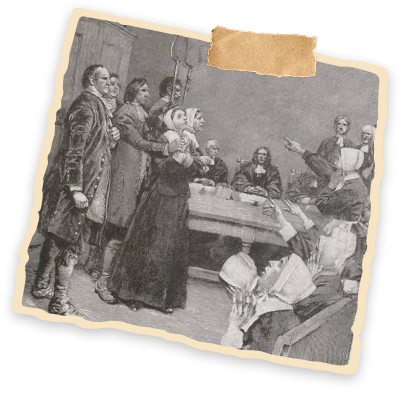
Samuel Wardwell was examined on September 1, 1692.
During that examination, he confessed to witchcraft and made a series of statements about encounters with the Devil, signing a book and participating in supernatural acts.
Confessions during the Salem Witch Trials must be understood within the extraordinary circumstances surrounding the proceedings. Accused people faced intense pressure, and confessing could sometimes provide a better chance of survival than maintaining innocence.
Wardwell did not allow his confession to stand.
By September 13, he had recanted it.
The surviving record says Wardwell stated that he had “belyed himselfe.” He also indicated that he believed he would die whether he admitted the accusations or denied them. His earlier fortune-telling was then used as part of the testimony against him.
Wardwell was convicted of witchcraft.
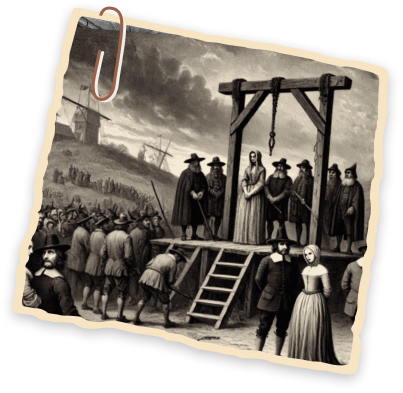
Samuel Wardwell was hanged on September 22, 1692.
He was executed alongside:
The eight were the final group executed by hanging during the Salem Witch Trials.
The execution site is now identified as Proctor’s Ledge in Salem, Massachusetts.
Samuel Wardwell left behind a wife and children whose lives were also deeply affected by the accusations and imprisonment surrounding the trials.
The Salem Witch Trials eventually collapsed, and attitudes toward the proceedings changed.
On October 17, 1711, the Massachusetts government passed legislation reversing the convictions and attainders of Samuel Wardwell and a number of others who had been prosecuted for witchcraft.
The act declared those judgments legally null and void.
Members of the Wardwell family also sought compensation for property and other losses suffered as a result of Samuel and Sarah Wardwell’s imprisonment and prosecution.
Nearly two decades after Samuel’s death, the government that had condemned him formally reversed the judgment against him.
For Michelle Peters, Samuel Wardwell is more than a figure from a history book.
He is family.
Michelle’s family genealogy traces her direct Wardwell line back to Samuel Wardwell, making him her 8th great-grandfather.
The line continues through Samuel and Sarah Wardwell’s son William Wardwell, who was born in Andover in 1679, and through generations of the Wardwell family before eventually reaching Michelle’s grandmother, Shirley Wardwell Palin.
Michelle’s father, Lawrence John Palin, was Shirley’s son.
More than 300 years after Samuel Wardwell became known for telling fortunes in colonial Massachusetts, one of his direct descendants would find her own path into divination and spiritual practice.
That connection is deeply personal to Michelle, but it is not presented as proof of inherited supernatural ability.
It is part of her family’s story.
The world Samuel Wardwell lived in was radically different from ours.
Practices involving fortune-telling, divination, folk belief and the supernatural existed throughout colonial society, but during the crisis of 1692, suspicion could become accusation, and accusation could become a death sentence.
Today, Michelle Peters owns The Charmed Emporium in Plainville, Connecticut, a place created for people to explore spirituality, divination, crystals, tarot and oracle cards, metaphysical tools, classes and readings without intimidation or judgment.
There is something meaningful about that contrast.
Samuel Wardwell lived in a time when telling fortunes became evidence against him.
More than three centuries later, his descendant can openly create a place where people are welcome to ask questions, explore spiritual practices and discover what resonates with them.
For Michelle, remembering Samuel is not about turning tragedy into mythology.
It is about remembering a real person, preserving a family story and recognizing how dramatically the world has changed since September 22, 1692.
There is no authenticated contemporary portrait known to depict Samuel Wardwell of Andover who was executed in 1692.
This is important because an oil painting labeled Samuel Wardwell appears in online searches.
It is not the Salem Witch Trials Samuel Wardwell.
That painting depicts a Samuel Wardwell of Cherry Valley, New York and was painted in 1807, approximately 115 years after the 1692 Salem executions.
For that reason, The Charmed Emporium does not present that portrait as an image of Michelle’s ancestor.
Whenever possible, we prefer to use authentic court documents, historical records and imagery connected to the actual events of 1692.
September 22 marks the anniversary of Samuel Wardwell’s execution.
His story is part of the larger tragedy of the Salem Witch Trials, but it is also a remarkably personal chapter of Michelle’s family history.
He was a husband, father, carpenter and fortune teller.
He lived in Andover.
He was accused.
He confessed and later recanted.
He was executed on September 22, 1692.
And in 1711, the judgment against him was formally reversed.
More than three centuries later, his story continues through the generations that followed him.
For Michelle and The Charmed Emporium, sharing that story is one small way of making sure Samuel Wardwell is remembered as more than simply another name from the Salem Witch Trials.

Samuel Wardwell is one chapter in a much larger story that shaped Michelle Peters’ connection to spirituality, divination and the creation of The Charmed Emporium.
Come visit the Emporium, learn more about Michelle, explore the shop, or book a reading.


Historical records establish that Wardwell was accused and convicted of witchcraft, but they do not establish that he personally identified himself as a witch in the modern sense of that word.
What can be documented is that he practiced fortune-telling and that this activity became part of the case against him.
© 2026 The Charmed Emporium. All rights reserved.
© 2026 The Charmed Emporium. All rights reserved.